Categories
Uncategorized

Rohith Vemula, Researching My Forthcoming Novel, and the Startling Persistences of Caste

Several years ago I went to India on a research trip for my now forthcoming novel Ghost in the Tamarind. The novel is set against the background of anti-caste politics in South India, and I was interested in visiting some of the places in which I meant to locate the story. Amongst these places was my mother’s ancestral village in Thirunelveli. I know this village well because I have been visiting it since I was a child. Just across the border from Kerala, the village nestles under the peaks of the Western Ghats and is surrounded by verdant rice fields. This is prosperous country, with the kind of settled beauty filled with history that represents the best kind of riposte to the crude truths of Orientalism—the kind of truths that are all about the “timelessness” and “stagnation” of the Indian village. (You can see the pictures from that research trip here on my website.)

It would be easy to get sentimental about my mother’s ancestral village, especially for someone like me, who has never lived there but has been raised to think of it as “home.” The seductions of roots are more real than one imagines; at the same time, as an incident during my research trip conveyed to me unmistakably, when it comes to history there is nothing more dangerous than sentimentality.

The incident occurred on the second day of my visit, as I wandered my way through the village to the sandy bend of the river that flows past. Arriving at the bend, I encountered the village’s washerman—a small lean man who with his wife was laundering clothes in the flowing river. Drying garments were spread out on the sand. A little distance away his donkey—the beast of burden on which he carried clothes back and forth—was tethered to a bush.

I stopped to talk to this man, and soon learned that he had inherited his job from his father, and that it was becoming less and less feasible for him to continue in his trade. My sons, he said, no longer do what I do. They have moved away from here, this village. I will be the last man to serve as washerman in this village.

I nodded, thinking to myself, yes, a modernizing society shatters traditional caste roles. I asked, wondering about his sons, What do they do?

And then he said the thing that to me encapsulates beautifully—horrifically—the conundrums of caste. The answer was startling, though perhaps I shouldn’t have been startled. One of the sons, it turned out, worked in the laundry room of a naval base in Kerala; and the other in a similar facility in a hospital in Chennai! They worked, my friend the washerman told me with pride, in a modern workplace with washing machines and driers.

You can leave your caste profession, I observed to myself, amending my previous thought. But your caste profession it seems won’t leave you.

What should one make of this? Of course, in one sense both my first and subsequent responses to what the washerman said to me are equally flawed. It would be a mistake to draw grand conclusions from one brief encounter. Still, this episode from years ago has always stuck in my mind. I was reminded of it again when I read the recent sad news from Hyderabad regarding Rohith Vemula, the Dalit PhD student who committed suicide because of the discrimination he experienced. In both Vemula’s tragic death and in the story of the washerman’s sons there is something worth thinking about, unsentimentally, regarding the tenacity of caste identities—the washerman’s two sons avail themselves of the opportunities of a modernizing society to travel far away, only to end up in the same profession as their father; Rohith Vemula embraces higher education as a pathway to a better life, only to find, as he writes devastatingly in his suicide note, that “the value of a man was reduced to his immediate identity and nearest possibility. To a vote. To a number. To a thing. Never was a man treated as a mind.”

Rohith Vemula’s suicide note is enough to break your heart. I am tempted to say that in it, just as in the story of the washerman and his sons, we see the unstoppable force of a modernizing society encountering the immovable rock of caste—but of course that is only a smart sounding half-truth. There are no unstoppable forces or immovable rocks in history. India may have its deeply rooted structures, but it cannot be reduced to the timeless fantasy of Orientalism.

When it comes to caste, there are only heartbreakingly difficult realities; and the unavoidable, unsentimental truth that India’s future depends on a sincere, democratic, inclusive—indeed, revolutionary—solution to the conundrum of caste. That solution is possible but it will be hard fought.

Categories
Uncategorized

Shakespeare Was Wrong–All the World’s Not a Stage: Sexuality and Freedom in Chennai

[Note—Picture Credits: Mohandas Vadakara]

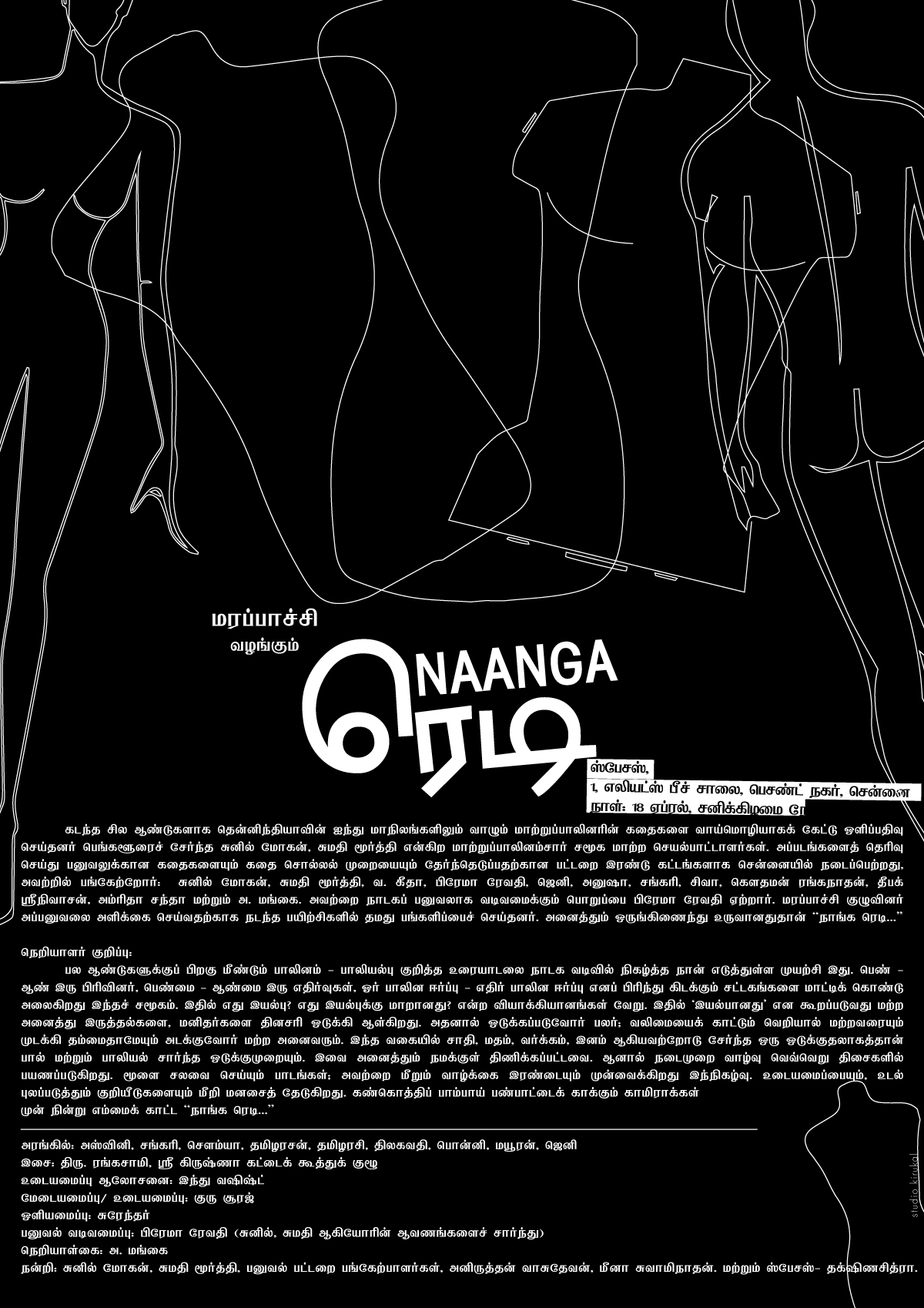
I recently saw Marappachi’s play Naanga Ready (We Are Ready) in Chennai. In an open-air auditorium called Spaces on Elliot’s Beach Road, I sat with the capacity audience on jamakaalams spread out over sandy ground. The evening was sultry and the Bay of Bengal lapped at the Chennai shoreline a short walk away. On the crowded beach, where I had gone for a stroll before coming to the play, vendors of all kinds plied their wares. The old and the young, the rich and the poor, had come to the beach to escape the heat. They strolled down to the water or else sat on a low wall to watch. Couples promenaded… no…

No, that won’t do. It won’t do to blithely write couples; as far as the world knew, heterosexual couples promenaded, sometimes with their families. If there were people on the beach who were not heterosexual (and surely there were), they were not visible.

IMG (264) A

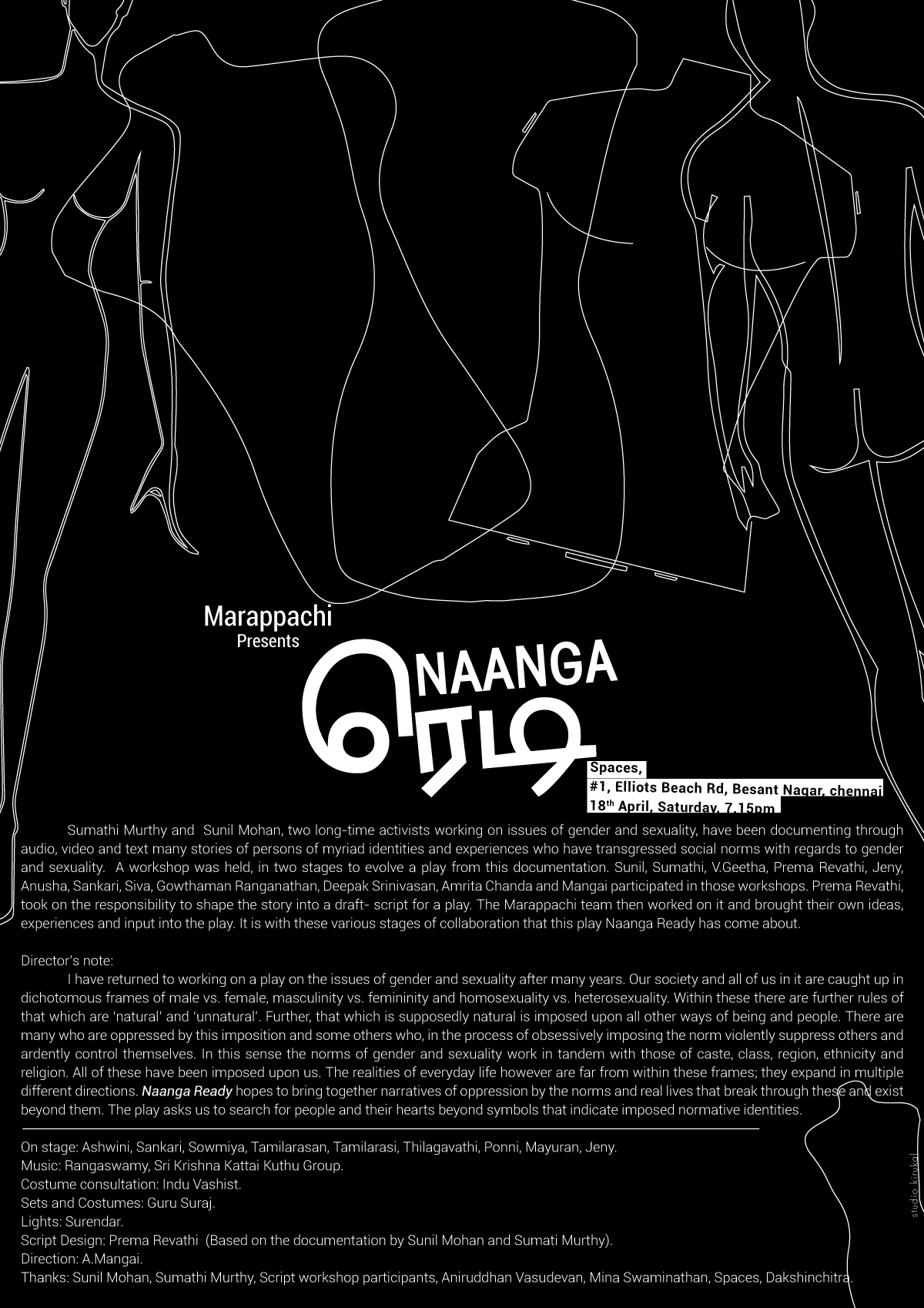
That was the beach. Inside the auditorium, things were different, for Naanga Ready tries to make visible that which society renders invisible. In a series of vignettes loosely held together by the characters, the play explores the impossible gender choices that society forces upon us. Mangai is the director and presiding impresario of the play, which was written by Prema Revathi based on interviews conducted by Sumathi Murthy and Sunil Mohan. Mangai is a veteran of alternative Tamil theatre in Chennai. Her roots are in equal measure in indigenous performance traditions like koothu and political theater from around the world (she is, I know, a keen reader of Kenyan playwright Ngugi wa Thiong’o). Both influences were apparent in Naanga Ready. The set design—a clothesline from which clothes and body dummies hung, a net from behind which a gay character spoke of his tortured relationship to his mother—was abstract and suggestive; and the impressive concluding sequences of the play featured folk traditions, including the performance of divine possession, prominently.

IMG (273) A

Rather than narrative drama, Naanga Ready is “movement theater” meant to articulate positions and provoke reflection. Ideas rather than narrative are at the heart of the play. That the play goes about its serious activist task without compromising entertainment value is an indication of its success. Naanga Ready initially makes its points about the “constructedness” of gender identities through humor. The powerful opening scenes of the play, set in a school for “gender correction,” are horrifyingly hilarious. Later the play turns more somber when the characters—representing a range of trans identities and sexual orientations—set out into the world to find jobs, housing, relationships, a measure of joy and security that the “normal” heterosexual world takes for granted. Based on actual interviews, these aspects of the play has an air of reality about it. The play’s strength is in creating for the audience through a cast that delivered strong performances a temporary space of safety where difficult truths can be spoken and acknowledged. (See the Naanga Ready leaflets in Tamil and English below for full credits.)

Shakespeare was wrong. All the world’s not a stage. Sometimes, thankfully, the stage is a welcome refuge from the unrelenting cruelties of the world. It is a bounded space of exploration in which to articulate ideas and desires ruled out of bounds in the world. Not all boundaries are bad. Theater has a long and distinguished tradition of calling intolerance to account from within its bounded space. Naanga Ready belongs proudly to this history. It calls to strict account the prejudices of the world at large, so blissfully taking the air on the beach nearby.

Nanga-Ready-A4-leaflet-Tamil

Nanga-Ready-A4-leaflet-English (1)

Categories
Uncategorized

Before There Is a Woman There Was a Girl: The Hard But Real Road to Empowerment

Before there is a woman there was a girl. In India, girls have to be eighteen before they can be married; but up to fifty percent of girls are forced by tremendous pressure to marry earlier. India’s constitution mandates education for all children until the age of fourteen; but two years later, at the end of Class 10, only thirty percent of girls are still in school. India is supposedly making tremendous economic gains; but only forty percent of women work for pay.

I learn these facts from Anusha Bharadwaj, the Executive Director of Voice 4 Girls in Hyderabad (full disclosure: she’s my niece), and Sharanya Nandini Gautam, the organization’s Development and Communications Officer. I am at the offices of Voice 4 Girls to visit my niece, and to see the other side of the story—that is, the other side of the litany of rapes and sexualized objectification that has become the story of Indian women. Since I blogged about the dark, sexist underbelly of Indian society recently (see “Full Spectrum Sexism” below), I feel obliged also to acknowledge the flip side—that across India there are many organizations like Voice 4 Girls, led by women, that successfully bring positive change into the lives of girls and women.

Voice 4 Girls—you can visit its website here: http://www.voiceforgirls.org/ and see videos about it here: http://www.vimeo.com/voice4girls—works in the states of Telangana and Andhra Pradesh. It runs holiday camps and year-long programs for adolescent girls who are mostly from urban and rural government schools maintained by the Tribal Welfare and Social Welfare Departments. The girls come from difficult social circumstances; they are largely from Scheduled Caste, Backward Caste and Scheduled Tribe low-income backgrounds. Voice 4 Girls empowers the girls by teaching them practical skills (spoken English, hygiene) alongside critical knowledge and life skills (elementary facts about their rights as citizens of India, strategies to recognize and deal with abuse). This curriculum, a judicious mix of the practical and the interventionist, is designed to be attractive to the girls as well as their parents.

What exactly is the change Voice 4 Girls has wrought? It is hard to quantify, but there are the wonderful stories that Sharanya shares with me—stories about girls like enterprising Manasa who has involved herself in a sustained way with the different programs of Voice 4 Girls, become a Sakhi (or student leader in her school), and even written a book! There are about 4000 such Sakhis. And over the four years of its existence, Voice 4 Girls has reached over 14000 girls through its camps and 55000 girls indirectly through its Sakhi program. Another 8000 girls will go through the summer camps this year. How can these numbers not be change of a kind, of the right kind?

As it happens, my visit to Voice 4 Girls ends with a lively discussion of the Vogue “My Choice” ad starring Deepika Padukone. That ad has come in for so much recent commentary about whether it really empowers women that I am determined to say nothing about it here beyond registering my opinion that it is less than what it seems. Whatever you yourself think of that ad, spare a thought too—and perhaps even a few bucks—for Voice 4 Girls and organizations like it. They may not be as glamorous as Deepika Padukone but they (too) walk the hard road to empowering women and the girls who become women.

Categories
Uncategorized

Full Spectrum Sexism: India’s Problem Isn’t Just Rape

As chilling as the rape in 2012 of Nirbhaya are the opinions of the lawyers of the convicted rapists. You can hear these opinions in the banned BBC documentary India’s Daughter. That doesn’t mean words spoken by ostensibly educated men who should know better—one lawyer declares he would set his own sister or daughter on fire if she were to engage in premarital sex—are equivalent to a horrific collective act of rape that resulted in unspeakable physical trauma to the body of the woman and, eventually, murder. One (rape) is as chilling as the other (expression of opinions) not because the two are equivalent in intention or in effect but because each reveals in its own way the depth of India’s problem.

India’s problem with sexism can’t be reduced just to rape; India’s sexism is far more wide-ranging and pervasive, seeping into the most ordinary of acts, in which men routinely belittle women in myriad ways or else, equally problematic, idealize them away into passive nonexistence. As the bizarre political posturing on India’s Daughter showed, shock at the rape of Nirbhaya is not incompatible with patronizing attitudes towards women (some male commentators, for example, declared that they did not need the BBC to protect “their” women, they could do it themselves). Some men just don’t seem to get it—rape is not an isolated social phenomenon separate from the ways in which they themselves relate to women. No, most men are not rapists, but neither are they not part of the problem. Are you a man who considers himself entitled to have his morning cup of coffee brought to him by a woman (your mother, your wife, your sister)? You are part of the problem.

India was always like this, but it wasn’t always exactly like this. I don’t suppose there is any period within memory that India was not patriarchal; still, we err if we think the present is always better than the past. Last week there was news of an attack on Puthiya Thalaimurai, a Tamil television station that had prepared a program debating the pros and cons of some women choosing not to wear the traditional “wedding necklace” (thaali). The program was cancelled when Hindu extremist groups objected and set off a bomb at the television studio in Chennai. When I read the news report, I was reminded of a scene from Komal Swaminathan’s great 1980 Tamil play Thaneer, Thaneer in which the female protagonist rips her thaali from her neck and throws it in her husband’s face to denounce him. Thaneer, Thaneer was a tremendous hit and played on stage for years. It was indeed controversial, but not for this scene in which a married woman discarded her thaali (the controversy concerned its ostensible Marxist-Leninist perspective). Now, we cannot even debate the thaali. Compared to 1980, what exactly is our “progress”?

To be blunt, contemporary India has a problem with women. I suppose it is necessary that I try to inoculate this blog against imbecilic attacks by noting (1) that the same could be said about every other country in the world, including the US where I have lived for a good portion of my life (the nature of the problem might differ but not the fact of its occurrence); and (2) that there are many aspects of Indian culture and the Indian present as well as past worth preserving and recovering for their potentiality to fight discrimination against women. These qualifications notwithstanding, the matter is simple: contemporary India has a problem.

There is no point in sticking your head in the sand about this: India suffers from full spectrum sexism. The phrase “full spectrum” originates in military doctrine and is used to describe a complete and comprehensive dominance over the enemy through every means available. It seems to me an appropriate term with which to characterize contemporary India’s problem with women—not the reality of Indian women, for after all women (and some men) through many deliberate as well as covert acts do get in the way of the achievement of a full spectrum sexism. I mean the phrase to identify patriarchal intention rather than reality.

Full spectrum sexism—that is India’s problem, and things won’t change until we understand and confront all that this phrase means.

Categories
Blog

The Literature and Politics of Shit (Shit Does Not Happen, It Is Allowed to Happen)

I

This might be the blog post nobody reads. Who wants to read about shit? (Yes, I too am wrinkling my nose.) But for reasons mentioned in this important Human Rights Watch report prepared by researcher Shikha Bhattacharjee there is no getting away from writing about it, especially now: http://www.hrw.org/news/2014/08/25/india-caste-forced-clean-human-waste.

There is no getting away from shit, period. It is the most human of things, and also the most inhuman.

II

I can remember visits as a child to the home of relatives in Thirunelveli in South India during which the inhumanity of shit in all its domesticated ordinariness was illustrated for me through a toilet. The toilet in this old and rambling house was an outhouse in the back, open to the sky and without a door. When in use, a chombu of water placed strategically on a wall was warning enough to await your turn. Inside was a long dry trough I remember well, only too well. It was cleaned manually by a scavenger (you should not have to ask me about this person’s social status), who daily came early in the morning before anyone in the house had need to go.

What does it mean that I remember this outhouse so vividly decades later? Let us just say that on my visits I woke up as early as I could.

III

This very outhouse makes a brief appearance in my last novel No End to the Journey, which is set in a similar village. But the most famous Indian novel in English about shit and manual scavenging is of course Mulk Raj Anand’s Untouchable, written nearly eighty years ago. In that novel, Anand, writing in the midst of the Indian nationalist movement, depicts the life of Bakha, an “untouchable” boy who is a manual scavenger. Towards the end of the novel, Anand has Bakha imagine the flush toilet as the utopian solution to his life of degradation. Technology, Bakha imagines, will free him from a desperate profession through which the untouchability of shit is reconstituted as the untouchability of his body and identity. Eighty years later, and manual scavenging still goes on in India. The technological solutions exist, as do the financial resources; still the horror of manual scavenging has not ended.

The simple truth about shit is that it doesn’t just happen, it is allowed to happen. Read the Human Rights Watch report.

IV

Some of my fellow Indians have no doubt begun to groan by now. They are thinking: One more bit of writing on shit in India! Hasn’t V. S. Naipaul done this already? Haven’t we had enough?

No, we haven’t—not as long as the outrage of manual scavenging exists. I’m no Naipaul. Long ago I wrote critically about him for his silly and ignorant declamations about shit and India. I am not about to join his camp. There are many things of which we Indians should justly be proud. I have written about some of them in earlier posts. Manual scavenging, however, is not one of them.

V

Manual scavenging is shameful, but the shame of it sticks to us (Indian and non-Indian, frankly) rather than the scavengers. Thank you, dear reader, for getting to the end of this post even if only with wrinkled nose.

Categories
Uncategorized

Namaste: a contrary reading in which, with advance apologies to lovers of yoga, thoughts are offered about Walter Benjamin, caste, untouchability, civilization, barbarism, and radical politics (all in the space of a brief blog)

The German Jewish philosopher Walter Benjamin famously observed, “There is no document of civilization which is not at the same time a document of barbarism.” Namaste, linked inextricably to the hands-pressed-together gesture that accompanies it, might be an excellent illustration of this thesis. Of course, to enter with me into an exploration of what I mean here you first have to consent to an expanded definition of “document,” where the term refers not just to something written, or even to a text in the way a film is a text, but rather to any unit in any system of signification or meaning-making. Thus, to arrange your body in a particular manner (as in placing your hands together in the gesture of namaste) is to produce a “text” full of meaning that must then be “read” by your interlocutor (the addressee of your greeting). It is in this way that I term namaste a “document.”

So much for a breezy review of cultural theory. The verbal text of namaste is generally translated as “I bow to you,” and in this sense, accompanied by the aforementioned pressed hands placed before the heart, is indeed a wonderful Indian greeting of humility, vulnerability, and open-ness to the other. But is that all it is? Let me play the provocateur here. Consider this. Europeans shake hands in greeting, Arabs embrace each other, Maori touch foreheads and let their breath mingle. And then we have Hindus, who namaste each other from a safe distance.

What’s going on here? How do we “read” this discrepancy? Is it possible there is an aversion to physical contact in namaste? To cut to the chase: can we separate this long-distance civility that Hindus engage in from the culture of untouchability that pervades India?

As is well known, untouchability, or rather strict rules about who may touch whom under what circumstances, is a fundamental feature of caste. It is associated with notions of impurity and is one of the most obnoxious features of caste prejudice. Is it not perfectly reasonable, then, to speculate that namaste is exactly the kind of greeting that a culture of untouchability would produce? Is it not probable that the civilized document of namaste hides within itself the barbaric code of caste prejudice?

Civilization and barbarism—scratch the surface of one and find the dark depths of the other. How tragically fitting that a man who died fleeing the horrors of Nazism should have (perhaps much too presciently) provided us with such potent insight into the relationship between the two.

“There is no document of civilization which is not at the same time a document of barbarism,” wrote Benjamin. What barbarism do you find in your cherished documents of civilization? Confronting that question might be the first step in a radical politics.