Categories
Uncategorized

The Broken Buddha Statues of Bamiyan, or Bringing Back the Political Buddha

I learn from my friend Bishnupriya Ghosh’s Facebook post that the shattered Buddha statues of Bamiyan in Afghanistan have been temporarily resurrected. The Taliban destroyed these statues in 2001. And now they have been revived as light images projected onto exactly the spot the statues occupied. I wonder what the Buddha would have thought of this resurrection of his purported stone likeness—this temporary revival of the likeness of a likeness.

The Buddha is famous for asking the woman who begged him to revive her dead son for a grain of rice from a house that had never experienced death—if she brought him such a grain he would perform the miracle of raising her son from the dead. The mother failed but I doubt her success in procuring a magical grain of rice was ever the point. The Buddha knew a thing or two about personal sorrow, or the cessation of it.

Today this Buddha—the Buddha of personal redemption—is the most prevalent. He is the Teacher who can lead you, without regard for the world at large, to a state of diminished sorrow. What a travesty—this is not the Buddha of history. Through their destructive acts the Taliban unintentionally remind us of a more complete picture of the Buddha. They are right to regard the statues of the Buddha as a threat, for the Buddha represents the antithesis of everything for which they stand.

The Taliban recognize the political force of the Buddha and so should we. If the broken Buddha statues of Bamiyan lead us to rescue the political Buddha from the clutches of the Buddha as lifestyle guru it would be an outcome well worth the loss of the statues.

Categories
Uncategorized

Great Literature Should Refuse the Hegemony of Its Times: On Komal Swaminathan’s Tamil play Thaneer, Thaneer and the Need to Resist Anti-Poor Sentiments

Just in the last few days two people have written to me about Komal Swaminathan’s great Tamil play Thaneer, Thaneer, proving that thirty-five years after it was first staged the play continues to resonate across the world. The play, which I translated into English as Water!, deals with themes of poverty, drought and crises of democratic governance. The news from everywhere suggests, unfortunately, that these are not issues of the past—the setting is a humble village in South India, the real drama far more general.

From Chennai Pennathur Ramakrishna of Madras Players, the oldest still active English language theater group in India, writes that they are planning to revive my English translation on the stage in November. Madras Players staged my English translation for the first time in Chennai’s historic Museum Theatre in 2012. Mr. Ramakrishna had stumbled across my translation in a bookstore in Chennai. He was familiar with the celebrated performances in 1981 of the original Tamil version, directed by Komal Swaminathan himself, and was moved to attempt the play in English. So successful was that attempt that now they are reviving it “by popular demand” (as Mr. Ramakrishna puts it).

A few days after Mr. Ramakrishna wrote to me a message arrived asking whether I had access to the original Tamil text of Swaminathan’s play—a South Asian theater company in California is exploring the possibility of staging the play in the original Tamil. Bonded laborer Vellaisamy, Swaminathan’s heroic protagonist, had to murder his cruel master just to escape the village of his birth. But now it appears he might be traveling all the way to California!

It is terrific to see Thaneer, Thaneer receive this kind of attention. The play is legendary in Tamil theater circles and deserves to be known widely. There is also a personal reason why this attention is gratifying. When I translated the play I first contacted a reputed editor in New Delhi about publishing it—this was before Naveen Kishore and Seagull Books in Kolkata, really the best home for the play because of their distinguished drama list, understood the true value of the play and put my translation in print. I got a reply from the New Delhi editor, who will remain nameless, deeming the play dated and out-of-step with the times.

It was 1999 and no doubt the play was then, as it is now, out of sync with the shocking and facile anti-poor sentiments that surround us. In his play, Swaminathan shows that the poor must not be regarded as objects of our or the state’s largesse but rather as (potential) agents of their own destiny. The play, about which I have written in a scholarly vein in several places, is not without its blindnesses but it stakes out with great passion and art uncomfortable truths about the plight of the poor. That is what makes the play so relevant—more relevant than ever with every passing year. The play is great literature because it resists the hegemony of its times—such resistance is not a sufficient condition of literary greatness but it is, I would think, a necessary one.

Categories
Uncategorized

Being Hindu in America: An Atheist’s Perspective on the California Textbook Controversy

Once again California public school textbooks are at the center of furious public debate. Groups that have declared themselves guardians of Hinduism are engaged in a campaign to rid California textbooks of what they consider grave, even discriminatory, errors.

Some of the controversy has concerned the use of the term South Asia instead of India—the aforementioned guardians of Hinduism abhor the use of South Asia to refer to what they regard as the historic area of India as a whole (that is India before partition in 1947). As a co-founder of SAMAR (South Asian Magazine for Action and Reflection), I am familiar with this terminological debate. When we dreamed up SAMAR in 1992 in Austin, Texas, we deliberately chose the term South Asia to signal an inclusive and anti-nationalist perspective—we wanted to address not just Indians but also people who traced their origins to other parts of South Asia like Pakistan and Bangladesh. In a small way, SAMAR contributed to the spread of South Asia as a widely employed term in the US.

It was clear to me then that South Asia and India had different and differently valid uses based on what one was trying to say. Nothing has happened to change my opinion. The use of the term India by Hindu nationalist groups to refer to a geographical area that today includes several countries other than India is patently absurd. What might be less clear to those not steeped in these recondite debates is that this is also an attempt to advance a militantly expansionist idea of India. Hindu nationalists dream of an Akhand Bharat or Unified India—an India unified that is under Hindu ideals—and to substitute India for South Asia wherever possible represents their desire to smuggle in this idea of Akhand Bharat through a series of displacements that it would take me too long to explain here.

Another part of the California textbook controversy concerns caste or rather, to use the term I usually prefer, the varna-jati complex. The same Hindu nationalists launching covert campaigns for Akhand Bharat work ceaselessly to minimize the role of caste discrimination in India. Caste is not just Hindu, they say; caste is not the rigid system that Orientalists make it out to be, they declare; caste is not the sole reality of India, they argue—all of which is true, as I have noted in my own writings on this subject, especially in my book Flesh and Fish Blood. What the Hindu nationalists fail to add is that caste is nevertheless more Hindu than not, that caste and the discriminations associated with it have proven stubbornly resistant to eradication, and that caste is certainly one of the most significant aspects of the reality of India.

Hidden in the California controversy lie other important questions: Who speaks for Hindus in America today? Who should speak for them? Are practicing Hindus alone permitted to weigh in on questions regarding Hinduism? What about an atheist like me, who was raised in Hindu traditions? And what about someone who is neither a practicing Hindu nor was raised in a Hindu family but who has studied Hinduism deeply in a scholarly way?

I have an anti-identitarian perspective on these questions—which is to say, I believe anyone can speak on these matters but no one, Hindu or non-Hindu, can be exempted from being knowledgeable and balanced.

I am an atheist from a reasonably devout Hindu family who has raised an Indian American son in the US. I know from personal experience and from the experience of my son that there is much ignorant stereotyping of India and Hinduism in the US. Putting my atheism aside for a moment, I think it is worth insisting that textbooks appraise Hinduism with the same evenhandedness that they might other religions (for example, by noting that Hinduism is not devoid of democratic impulses), and that they be aware of the ways in which misconceptions about Hinduism might be used to bully Indian American children from Hindu families.

On the other hand, Hinduism has certainly been the basis for the abjection and rank oppression of large groups of people including Dalits—which is one of the reasons I am an atheist. Surely Dalit American children in California deserve the same right to a truthful assessment of their historical reality that Hindu American students do? Given the enormity of historical crimes done to Dalits and others regarded as “low caste” there can be no compromise here, no sentimentalism about tradition.

In the final analysis, Hinduism is as much a social phenomenon and cultural tradition as it is a religion; and in this context I have as much right to speak of it—as well as, if necessary, against it—as a devout Hindu.

Categories
Uncategorized

Rohith Vemula, Researching My Forthcoming Novel, and the Startling Persistences of Caste

Several years ago I went to India on a research trip for my now forthcoming novel Ghost in the Tamarind. The novel is set against the background of anti-caste politics in South India, and I was interested in visiting some of the places in which I meant to locate the story. Amongst these places was my mother’s ancestral village in Thirunelveli. I know this village well because I have been visiting it since I was a child. Just across the border from Kerala, the village nestles under the peaks of the Western Ghats and is surrounded by verdant rice fields. This is prosperous country, with the kind of settled beauty filled with history that represents the best kind of riposte to the crude truths of Orientalism—the kind of truths that are all about the “timelessness” and “stagnation” of the Indian village. (You can see the pictures from that research trip here on my website.)

It would be easy to get sentimental about my mother’s ancestral village, especially for someone like me, who has never lived there but has been raised to think of it as “home.” The seductions of roots are more real than one imagines; at the same time, as an incident during my research trip conveyed to me unmistakably, when it comes to history there is nothing more dangerous than sentimentality.

The incident occurred on the second day of my visit, as I wandered my way through the village to the sandy bend of the river that flows past. Arriving at the bend, I encountered the village’s washerman—a small lean man who with his wife was laundering clothes in the flowing river. Drying garments were spread out on the sand. A little distance away his donkey—the beast of burden on which he carried clothes back and forth—was tethered to a bush.

I stopped to talk to this man, and soon learned that he had inherited his job from his father, and that it was becoming less and less feasible for him to continue in his trade. My sons, he said, no longer do what I do. They have moved away from here, this village. I will be the last man to serve as washerman in this village.

I nodded, thinking to myself, yes, a modernizing society shatters traditional caste roles. I asked, wondering about his sons, What do they do?

And then he said the thing that to me encapsulates beautifully—horrifically—the conundrums of caste. The answer was startling, though perhaps I shouldn’t have been startled. One of the sons, it turned out, worked in the laundry room of a naval base in Kerala; and the other in a similar facility in a hospital in Chennai! They worked, my friend the washerman told me with pride, in a modern workplace with washing machines and driers.

You can leave your caste profession, I observed to myself, amending my previous thought. But your caste profession it seems won’t leave you.

What should one make of this? Of course, in one sense both my first and subsequent responses to what the washerman said to me are equally flawed. It would be a mistake to draw grand conclusions from one brief encounter. Still, this episode from years ago has always stuck in my mind. I was reminded of it again when I read the recent sad news from Hyderabad regarding Rohith Vemula, the Dalit PhD student who committed suicide because of the discrimination he experienced. In both Vemula’s tragic death and in the story of the washerman’s sons there is something worth thinking about, unsentimentally, regarding the tenacity of caste identities—the washerman’s two sons avail themselves of the opportunities of a modernizing society to travel far away, only to end up in the same profession as their father; Rohith Vemula embraces higher education as a pathway to a better life, only to find, as he writes devastatingly in his suicide note, that “the value of a man was reduced to his immediate identity and nearest possibility. To a vote. To a number. To a thing. Never was a man treated as a mind.”

Rohith Vemula’s suicide note is enough to break your heart. I am tempted to say that in it, just as in the story of the washerman and his sons, we see the unstoppable force of a modernizing society encountering the immovable rock of caste—but of course that is only a smart sounding half-truth. There are no unstoppable forces or immovable rocks in history. India may have its deeply rooted structures, but it cannot be reduced to the timeless fantasy of Orientalism.

When it comes to caste, there are only heartbreakingly difficult realities; and the unavoidable, unsentimental truth that India’s future depends on a sincere, democratic, inclusive—indeed, revolutionary—solution to the conundrum of caste. That solution is possible but it will be hard fought.

Categories
Uncategorized

Poverty, Surveillance, Cooptation: Three Thoughts on MIA’s Extraordinary Music Video “Borders”

In “Borders,” her recent music video, artistic provocateur MIA broaches a subject of great urgency—the contemporary refugee crisis. Performed and directed by MIA, this remarkable and widely reviewed music video presents humanity on the move—clambering over fences, marching in long files across dusty landscapes, setting forth on boats across the ocean. Here’s the video if you haven’t seen it yet:

MIA, “Borders”

And here are three thoughts on the video:

  • Poverty: Released in November 2015, a few months after the migrant crisis in Europe (often identified in the media as the Syrian refugee crisis) peaked during the summer, the music video has been most commonly seen as referring to that crisis. It’s worth noting however that MIA does not in fact specify the reasons the migrants featured in her video are on the move. As MIA herself has noted, her background includes being a Tamil refugee in Britain fleeing the political violence in Sri Lanka. Are the young brown men featured in the video meant to be political refugees? Perhaps, but the true power of the video lies in not focusing on a reason for the flight of these young men. By not identifying any immediate cause the video directs attention to a world structured in racial and economic as well as political exclusion—rather than episodic (Sri Lanka yesterday, Syria today, some other place tomorrow), the problem is structural. “Broke people (what’s up with that?)” goes one of the lines of the song. War and genocide are not the only reasons people are on the move across continents. Poverty is a reason too.
  • Surveillance: We live in a world filled with surveillance. Commentators have noted the fence that plays such an important role in the video. The surveillance camera that is perched on top of the fence has not received the same commentary. The camera features in many of the frames of the video, including one in which MIA is shown balanced over it. The camera indicates that the men clambering over the fence are being watched. There’s political intentionality behind borders of exclusion and the camera draws attention to that intentionality. The people who set up the fences haven’t abandoned the fences. They are watching and waiting for the men, and who can say what welcome they will give the men on the other side of the fence? Think Donald Trump. And we who browse the Internet and watch the camera watching the men—what welcome are we prepared to give?
  • Cooptation: Controversy has been raised about this video on exclusionary borders appearing on the platform of one of the mightiest corporations in the world (Apple). Let’s be frank—this is a problem worth thinking about. Corporations are not innocent when it comes to exclusionary borders. It might take sustained critical work to uncover their guilt, but implicated they most certainly are. It’s the old problem of cooptation (check out the Che tee shirt). Have MIA and her video been coopted? “Your privilege (what’s up with that?)” MIA asks her viewer in another line from the song, rightly suggesting the implication of we who browse the Internet on our laptops. Of course that question is even more resonant when aimed at a celebrity like MIA. Is MIA already aware of this issue? Is that why she’s the only woman in a video filled with men? The only one wearing fashionable sunglasses? And the only one picked out by a spotlight in the concluding frames of the video? Or is it rather that she is a self-obsessed celebrity? Round and round cooptation makes us go with its questions. Here’s the real question: what are we going to do with this knowledge of the problem of cooptation?
Categories
Blog

The Story of Ashoka, the King Who Gave Up Conquest (or Embracing Possibility in an Age of Hopelessness)

Paris / 11.13.2015
Beirut / 11.12.2015
Gaza / July 2014
Abu Ghraib / 2003
Gujarat / February 2002
New York /9.11.2001
Sri Lanka / July 1983
[Fill in place and date of your choice]

We tell stories—we are what our stories make of us.

We have a right to the oil under distant desert sands because we are a modern and industrious people—that is a story.

Terrorism is necessary to fight the empire—another story.

We have the right to kill those who abuse our religion—a story.

No place for idealism in governing. Ruling and exercising power requires making hard and unsentimental choices—the most insidious of stories, a story meant to make us helpless, disorient us morally. A story that has given us drone strikes and torture and extraordinary rendition.

I remember other stories.

As the great Nigerian writer Chinua Achebe often said, the special work of the storyteller is to keep the stories we care about from disappearing. So here is a story I want to keep from disappearing.

Once upon a time there was a king who gave up conquest, committed himself to nonviolence, and embraced wholeheartedly the welfare of his subjects. That king’s name was Ashoka and he ruled from 268 to 232 BCE in that part of the world we now call India.

Early in his life, Ashoka was a bloodthirsty conqueror. In 260 BCE, this warrior king fought a ferocious battle to subdue stubborn Kalinga. Ashoka won. Kalinga was subdued. But the morning after his victory, as Ashoka picked his way through the rotting and crow-pecked bodies littering the battlefield, the great king was brought low by grief. Shocked at the devastation wrought by his violent quest to expand his empire, Ashoka resolved to give up conquest and to devote himself to rule through ahimsa, or nonviolence. He resolved to choose compassion and the welfare of his people over the vainglorious expansion of his empire. This new resolve of the king you can still find etched as edicts on rocks scattered across what was once his vast empire.

Ashoka ruled for nearly forty years. His name means “one without grief.”

This is a story about the happy union of the ideal and the possible. This is the story I choose to remember today.

Categories
Uncategorized

The Coward’s Manifesto, or I Want to Write about Guns but I’m Afraid

“I would not just stand there and let him shoot me,” [Presidential Candidate] Mr. [Ben] Carson, who has been surging in recent polls, said on Fox News. “I would say: ‘Hey, guys, everybody attack him! He may shoot me, but he can’t get us all.’ ” –Reported in the New York Times (Oct. 6 2015)

I’m afraid. What if somebody doesn’t like what I write?

It’s not as if I am silly to be afraid. It’s not as if shootings are so rare in America.

Another month, another five or ten or twenty dead on an American college or school campus. (Why such hatred of young people? What is it about young people trying to educate themselves that brings out such violence?)

In response to the latest shooting, my university’s Department of Public Safety sends out an email about “active shooter” situations. Do I want to be trained on what to do?

No, I don’t want to be trained. I just want to teach my classes, and I just want to live in a society where ordinary people like me don’t have to get trained by our employers in what to do in “active shooter” scenarios.

Imagine that. What two-hour session could ever train me to protect myself, my students, my colleagues from “active shooters?”

Don’t get me wrong—I think it’s great that my university’s Department of Public Safety is being proactive with this “active shooter” training stuff. Better something than nothing, I’m sure.

Still, I don’t think I should go to the training, well intentioned as it is. I would just waste everybody’s time. I would look up the etymology of the word active. I would start thinking about how to translate the phrase into other languages I know as a way of understanding it “culturally.” I would want to deconstruct the difference between an active and inactive shooter. I would test everyone’s patience by engaging in some ideology critique.

Or, if I were feeling less theoretical, I would raise my hand and ask: Is there a separate training for what to do with inactive shooters? Is that the session in which we talk about how to strengthen laws to keep guns out of the hands of shooters so that they don’t go from inactive to active and start raining bullets on us all?

You see, I just want to live in a society where, if someone disagrees with me or violently dislikes me, at most they will argue with me, or else beat me up or attack me with a knife or a stone. Of course, I would not like being attacked physically. Argument I might welcome as an invitation to citizenly debate, but being attacked by a knife? That I would not welcome at all. Still, I find knives preferable to guns.

I confess. I am a coward. And I know guns don’t kill people, people kill people. Which is why, coward that I am, I prefer people not having guns. I have a pretty strong hunch I would have much better luck running away from people with knives than people with guns.

I know none of this is very brave of me. But I don’t care. Don’t we cowards have the right to a reasonable chance of running away should someone decide to come at us violently? After all, we too are citizens and human beings. If you prick us, do we not bleed?

Why should we be sacrificed—again and again, in horrifying tragedy after horrifying tragedy—because some people want guns so they can play at being brave?

Don’t we cowards too have our inalienable rights? Where is our amendment to the US constitution—the one that reads “the right of reasonable and sane people to take to their heels to save themselves in the face of violent physical attack shall not be infringed?”

Categories
Uncategorized

Game of Thrones, Neo-Orientalism, and the Politics of Inoculation: Calling Postcolonial Criticism to Account

It is 2015 and a kind of Orientalism, with apologies to Edward Said, is alive and well. Should you doubt me, watch the hit TV show Game of Thrones. I am surely not the first to judge the show in this regard (see http://www.newstatesman.com/blogs/tv-and-radio/2012/06/game-thrones-and-good-ruler-complex). If in the show Westeros is vaguely medieval Europe, the world across the sea from Westeros is all timeless Orient. Orientalism as the centuries-long clichéd and historically inaccurate portrayal of Asia and North Africa provides the content of this world. Turbans and decadence. Brown people and slavery. Deserts and caravans. All are shamelessly represented in the lands far from the all-too-aptly named Westeros.

Bad you might say, but Game of Thrones gets worse still. Not satisfied with reproducing a historically untenable opposition between the West and the Orient (remember Martin Bernal’s argument for the Afroasiatic origins of classical European civilization in Black Athena?), the show pursues an even more insidious depiction of the Orient, leading us to ask: why is it that the show makes no room even in its fantasy world for consequential characters who are not white? how is it that few non-white characters ever manage to do anything significant in it? and if they do are promptly killed and disappear from the show? The answer to these questions is clear—it is the old and tired association of agency with whiteness, as if you must be white to have the capacity to act, to make history.

But, still, Game of Thrones is not quite Orientalist in the way the nineteenth century novels that Said studied in his classic 1978 work Orientalism were. The scene that concludes Season 3 is enough to illustrate my point. The silver-blonde ever-so-white Daenerys Targaryen at the head of a great army has just freed the slaves of a city and now they surround her in a brown horde. From high above, the camera looks down on her, a white dot in the middle of a sea of brown-ness. Brown slaves with their white savior. It is pure Orientalism, isn’t it? But no, wait, the camera zooms closer and we now see in the crowd of slaves one or two pale faces. A white arm here and another there. In a sea of brown-ness, close up, a few specks of white.

Thus Game of Thrones would seem to protect itself from the charge of Orientalism—Orientalist? Not at all! Can’t you see the white slaves in the crowd?

It is true. Game of Thrones is only Orientalist in a kind of way. Rather, more accurately, it’s neo-Orientalist—Orientalist with a twenty-first century twist. Nearly forty years have passed since Said’s seminal critique, and after all the postcolonial studies classes that scores, perhaps hundreds, of professors have taught and are still teaching in American and European universities we get the neo-Orientalism of Game of Thrones. All that the postcolonial criticism of forty years and more seems to have taught the makers of the show is how to insulate it from the charge of prejudice by throwing in a few white faces and bodies here and there to mask the association of slavery with brown people—not to discard Orientalism, mind you, nor to challenge or undo fantasies of Oriental abjection and Occidental vigor, but simply to disguise the fantasies, package them in more palatable forms, so as to inoculate a tried-and-tested Orientalist narrative from charges of racism.

All that labor—all that careful and principled education of young minds in postcolonial studies classes—has it all been for nothing? Has it done little more than instigate a politics of inoculation meant to ensure the survival with a vengeance of hoary racist and Orientalist fantasies?

(PS: Much might also be written about how the show practices a politics of inoculation with regard to its representation of women.)

Categories
Uncategorized

Bobby Jindal Is So White: Reflections on Being South Asian in America in 2015

It’s hard being South Asian in America. Just ask Bobby Jindal, he’ll tell you. It’s so hard, he’s white.

After all, if you are South Asian you live your life in the public eye as a stereotype. As a doctor or a software engineer. A cabdriver or an abused domestic worker. Or a terrorist.

Bobby is no terrorist. He is a politician. He is the Governor of the State of Louisiana. And he’s running for President.

That is why Bobby is white. That is why he can’t be brown. No way, no how. Think about it. When was the last time America had a brown president?

It is true America has a black president. Bobby knows Barry is black. But he doesn’t want to be black for the same reason he doesn’t want to be brown. His way of getting taken seriously requires him to be white. Anything else is exhausting for Bobby.

There have been a few times—as in, a few times every day when he passes a reflection of himself—when the thought has crossed Bobby’s mind that he might, really, when all is said and done, still be brown. Bobby doesn’t like that. He doesn’t like the unwelcome intimation of his possible brownness trudging wearily across the desert of his mind. Like some undocumented migrant worker crossing into Arizona from Mexico.

It’s exhausting for Bobby. Thinking about being a South Asian in America in 2015. Getting people to take you seriously as a politician because—no, make that, if—you are brown. Exhausting. Even though you were born here. And have a certificate to prove it. Exhausting.

Bobby doesn’t like being exhausted—so much easier to be white!

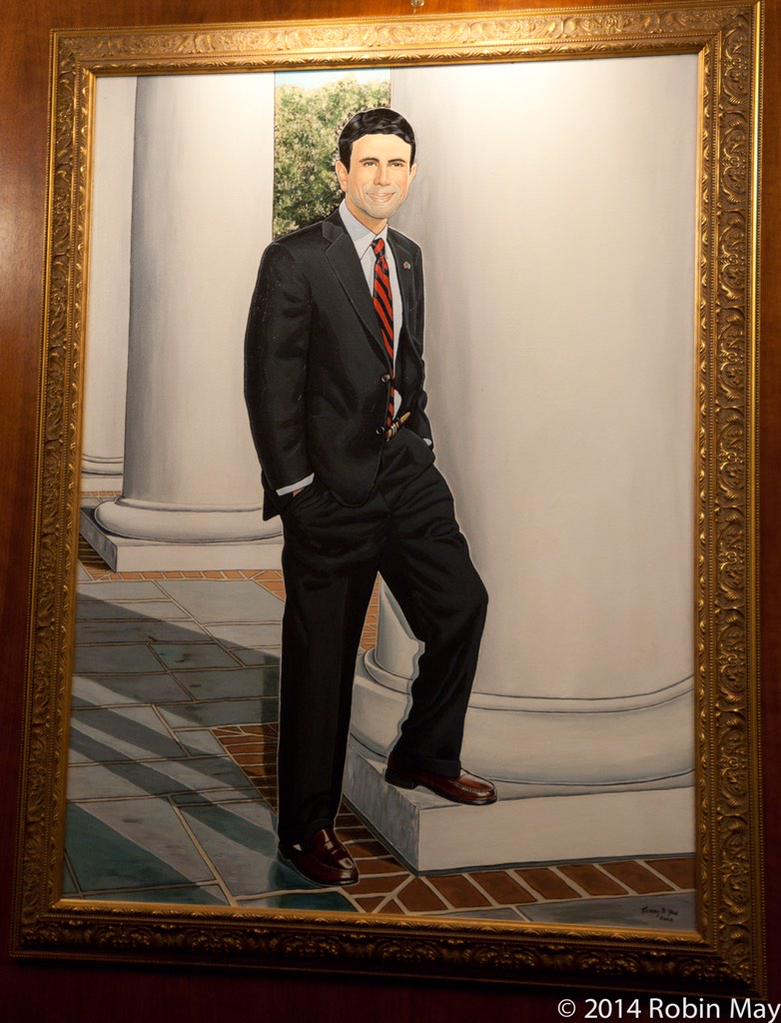
No, Bobby can’t be brown. It just won’t do. Bobby is not a doctor or a software engineer. Or a cabdriver or an abused domestic worker. Or a terrorist. He is a politician. The two-time Governor of Louisiana. And he is running for President. He can’t be brown—it’s just too hard being a brown politician. That is why he is white, so white. See his portrait, if you don’t believe Bobby:

B88qGdKIcAEG66Q.jpg-large

Bobby Jindal is so white his first act as President would be to deport his own father for being brown.

Categories
Uncategorized

Shakespeare Was Wrong–All the World’s Not a Stage: Sexuality and Freedom in Chennai

[Note—Picture Credits: Mohandas Vadakara]

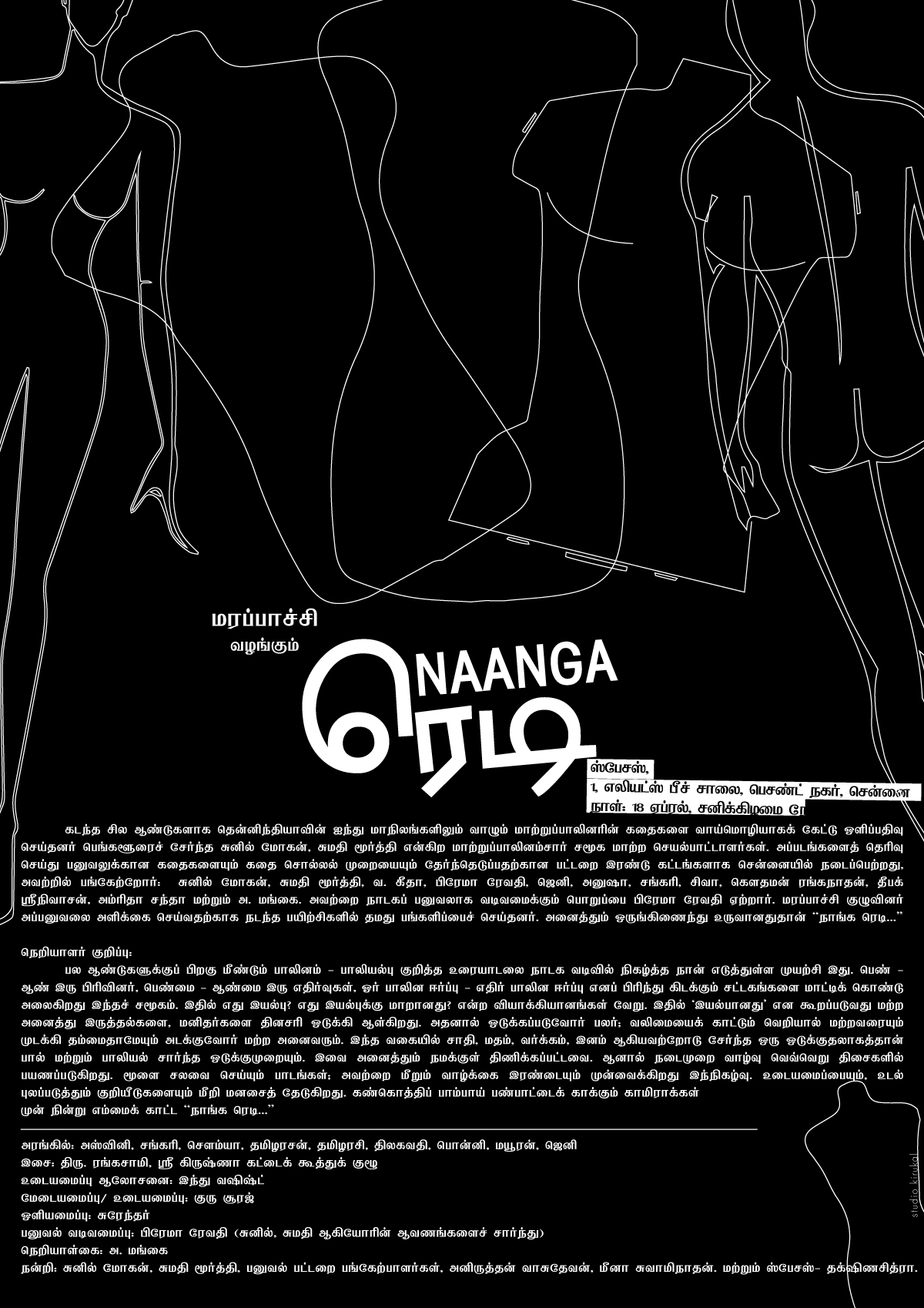
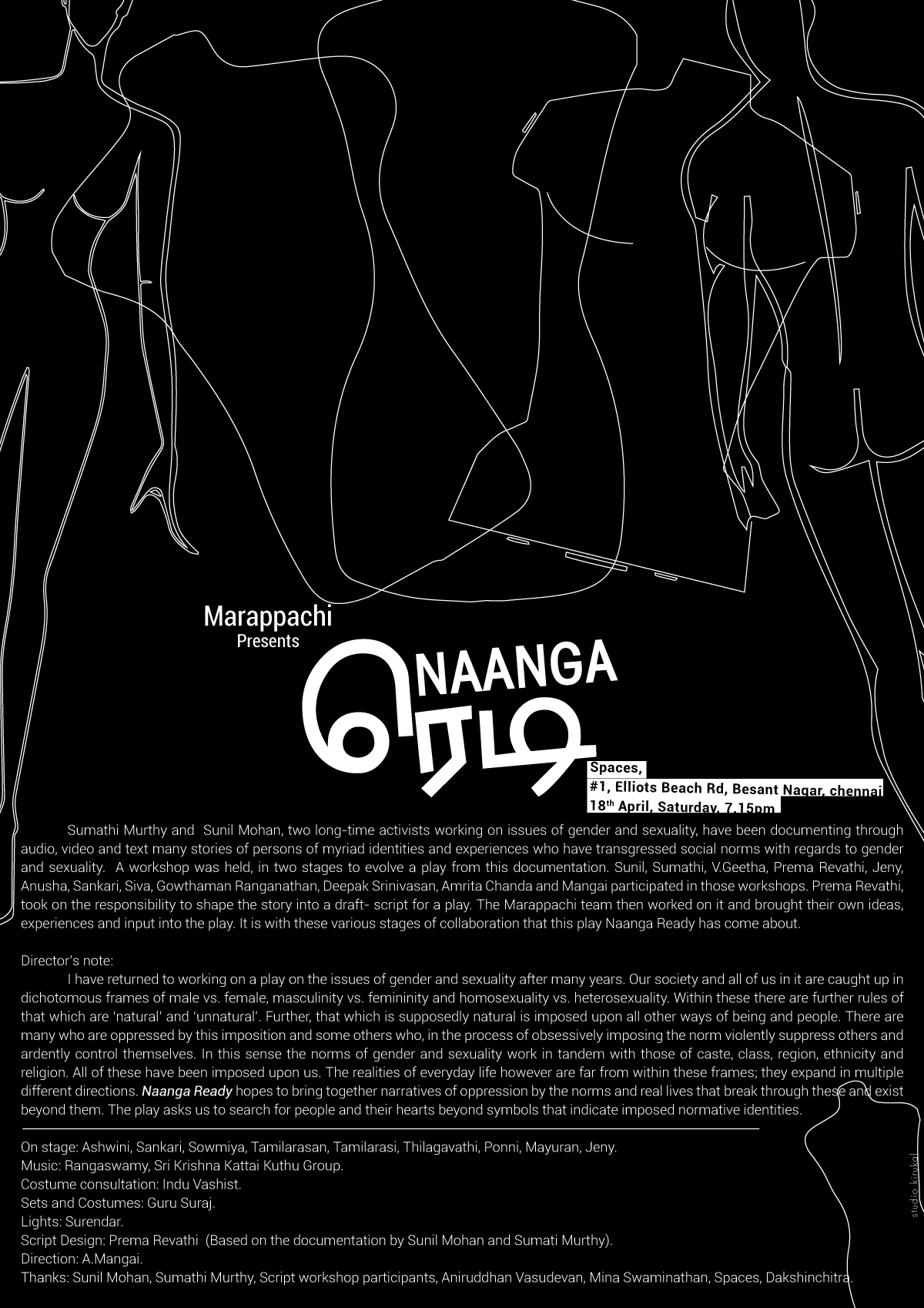
I recently saw Marappachi’s play Naanga Ready (We Are Ready) in Chennai. In an open-air auditorium called Spaces on Elliot’s Beach Road, I sat with the capacity audience on jamakaalams spread out over sandy ground. The evening was sultry and the Bay of Bengal lapped at the Chennai shoreline a short walk away. On the crowded beach, where I had gone for a stroll before coming to the play, vendors of all kinds plied their wares. The old and the young, the rich and the poor, had come to the beach to escape the heat. They strolled down to the water or else sat on a low wall to watch. Couples promenaded… no…

No, that won’t do. It won’t do to blithely write couples; as far as the world knew, heterosexual couples promenaded, sometimes with their families. If there were people on the beach who were not heterosexual (and surely there were), they were not visible.

IMG (264) A

That was the beach. Inside the auditorium, things were different, for Naanga Ready tries to make visible that which society renders invisible. In a series of vignettes loosely held together by the characters, the play explores the impossible gender choices that society forces upon us. Mangai is the director and presiding impresario of the play, which was written by Prema Revathi based on interviews conducted by Sumathi Murthy and Sunil Mohan. Mangai is a veteran of alternative Tamil theatre in Chennai. Her roots are in equal measure in indigenous performance traditions like koothu and political theater from around the world (she is, I know, a keen reader of Kenyan playwright Ngugi wa Thiong’o). Both influences were apparent in Naanga Ready. The set design—a clothesline from which clothes and body dummies hung, a net from behind which a gay character spoke of his tortured relationship to his mother—was abstract and suggestive; and the impressive concluding sequences of the play featured folk traditions, including the performance of divine possession, prominently.

IMG (273) A

Rather than narrative drama, Naanga Ready is “movement theater” meant to articulate positions and provoke reflection. Ideas rather than narrative are at the heart of the play. That the play goes about its serious activist task without compromising entertainment value is an indication of its success. Naanga Ready initially makes its points about the “constructedness” of gender identities through humor. The powerful opening scenes of the play, set in a school for “gender correction,” are horrifyingly hilarious. Later the play turns more somber when the characters—representing a range of trans identities and sexual orientations—set out into the world to find jobs, housing, relationships, a measure of joy and security that the “normal” heterosexual world takes for granted. Based on actual interviews, these aspects of the play has an air of reality about it. The play’s strength is in creating for the audience through a cast that delivered strong performances a temporary space of safety where difficult truths can be spoken and acknowledged. (See the Naanga Ready leaflets in Tamil and English below for full credits.)

Shakespeare was wrong. All the world’s not a stage. Sometimes, thankfully, the stage is a welcome refuge from the unrelenting cruelties of the world. It is a bounded space of exploration in which to articulate ideas and desires ruled out of bounds in the world. Not all boundaries are bad. Theater has a long and distinguished tradition of calling intolerance to account from within its bounded space. Naanga Ready belongs proudly to this history. It calls to strict account the prejudices of the world at large, so blissfully taking the air on the beach nearby.

Nanga-Ready-A4-leaflet-Tamil

Nanga-Ready-A4-leaflet-English (1)